FJI-UNDERCOVER: Europe Through the Sahara Desert and the Mediterranean Sea (I)
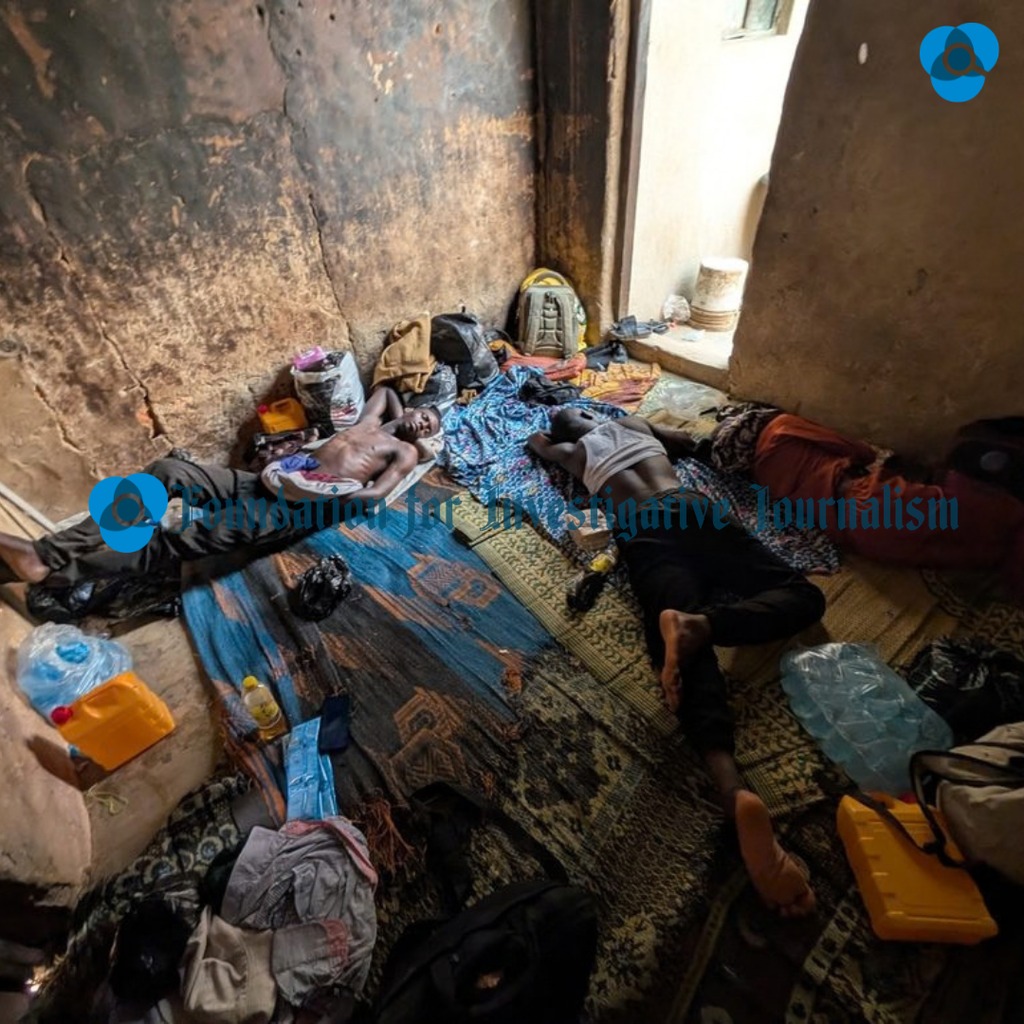
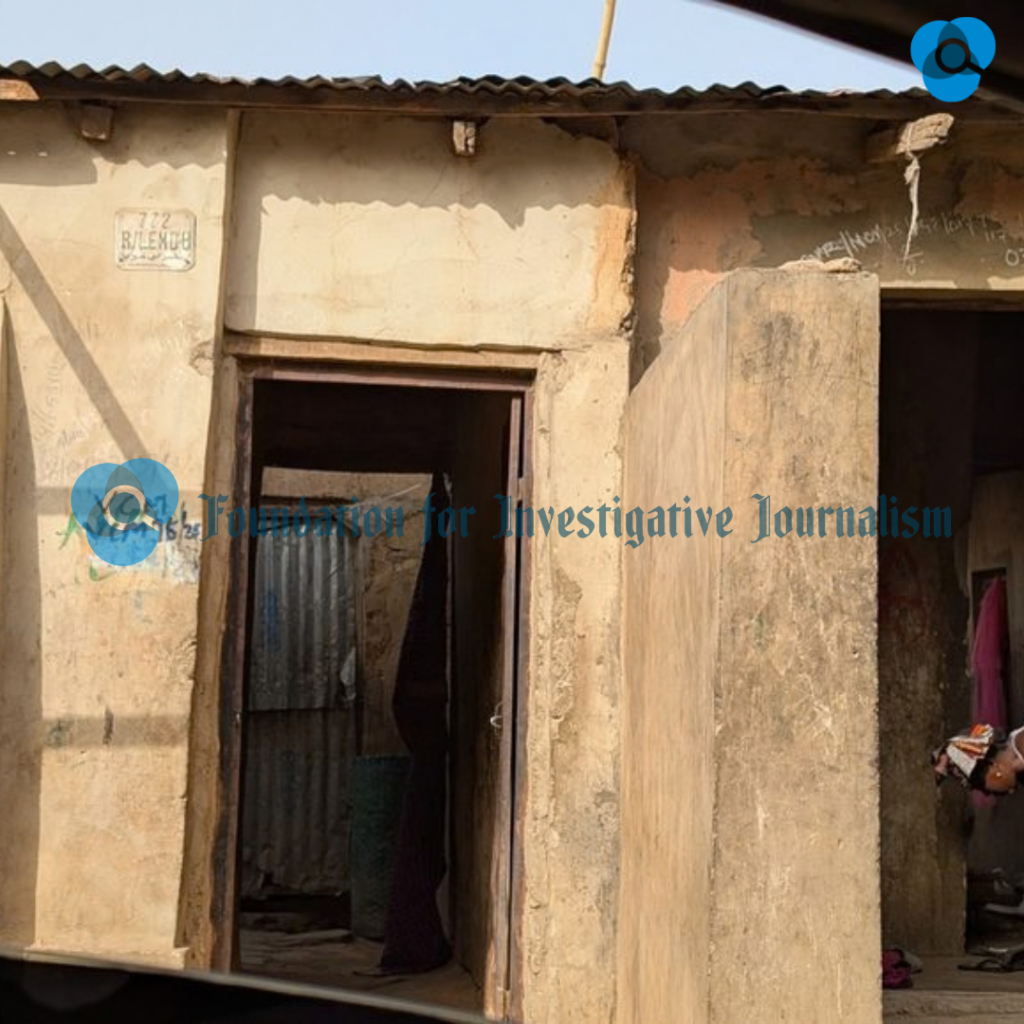
Inside a Kano migrant house where Europe-thirsty Nigerians hide while awaiting connection to Magaria in the Zinder region of Niger Republic. Photo credit: ‘FISAYO SOYOMBO/FIJ
Nearly every day in Agadez, a sandy, windswept town in the north of Niger Republic, West Africa, scores of trucks stuffed with African migrants barrel out of town and across the parched and cracked earth, dust swirling around their swivelling tyres, human feet dangling precariously from all sides, on a perilous multi-week journey through the inhospitable Sahara Desert into Libya in the Maghreb region of North Africa, hoping to cross the Mediterranean Sea into Europe, particularly Italy. Investigative journalist ‘FISAYO SOYOMBO spent 47 days as one of them, journeying from Kano in Nigeria through notorious illegal migrant hubs Zinder, Agadez and Dirkou in Niger, and al Gatrun and Sabha to Tripoli in Libya. He returns to document tales of deaths, starvation, rape, dehumanisation, mental abuse, physical assault, abductions, torture, and modern-day enslavement of citizens of Nigeria, Ghana, Niger, South Sudan, Eritrea and Somalia by Arab traffickers who treat dogs better than black Africans.
You are the Lord, that is your name
You will never share your glory with anyone
You will never share your glory with anybody
Almighty Lord, that is your name.
This was a sombre rendition by five young men in a dingy, teeming room with a pungent smell in Rijiyar Lemo, Fagge Local Government Area of Kano in northwestern Nigeria. Three more men sat idling away by the doorway. I was the ninth, the most recent addition. In an adjoining room were girls numbering up to six, all of us awaiting the next steps in our excitingly anticipated journey to the desert.
No migrant has full knowledge of the risks awaiting them in the nearly endless, mostly fruitless odyssey to Libya, but the quintet at least possessed a sparse idea. Nobody voyaging through the desert is guaranteed to arrive in Libya physically intact. The quintet knew enough to seek supernatural intervention. Most migrants do, anyway. Over the coming seven weeks, I would meet migrants who procured incisions on their bodies, including their privates, courted prophets, or even visited native witch doctors. I understood why. I had been warned of a significant risk of perishing in the desert, languishing in kidnappers’ dens, or returning physically maimed.
There were physical preparations too. My tailor gazed at me in disbelief when I nudged her to carve out an inside pocket in the torso area of my jeans; this was where I tucked cash away from the marauding hands of desert bandits and robbers, the latter a broad group that ironically includes the police and the army. I slung on a laptop-size bag housing personal hygiene items including a toothbrush, toothpaste and an antiperspirant, and breakfast staples such as cereals, noodles, milk and tea. Finally, in that bag, I carried with me a compact GPS tracker with which my backroom team could monitor my location anywhere in the world. I could not control the outcome of my expedition, but I could ensure someone knew if — and where — something went wrong. We timed the tracker to hourly location updates. Two people monitored it. From their phones, they journeyed along with me. Every hour.
Inside a Kano migrant house where Europe-thirsty Nigerians hide while awaiting connection to Magaria in the Zinder region of Niger Republic. Photo credit: ‘FISAYO SOYOMBO/FIJ
The passage from Lagos to Kano in the early hours of Friday May 22, 2026, was the first and only uncomplicated leg of the trip. I had jetted into Nigeria’s second most populous state, but Alhaji Buzu (real name Buhari Umar Adamu), my ‘connection man’, believed it was a road trip. Once I confirmed I was nearing Kano, Alhaji Buzu (phone number +218916087xxx) ‘connected’ me to Ismael Abubakar (phone number +2347060507xxx) who would inherit the next leg of my journey. Ismael’s job was to facilitate my trip to Magaria, a farming and herding town in the Zinder region of southern Niger, where I would then be connected to someone else for the next leg of the journey. As the name suggests, a ‘connection man’ is a background trafficker who links an illegal migrant to an active trafficker, who in turn provides a linkup to the next active trafficker, on and on until the migrant arrives at their destination. A trip from Nigeria to Libya is typically coordinated by one connection man with 20 to 30 traffickers in between.
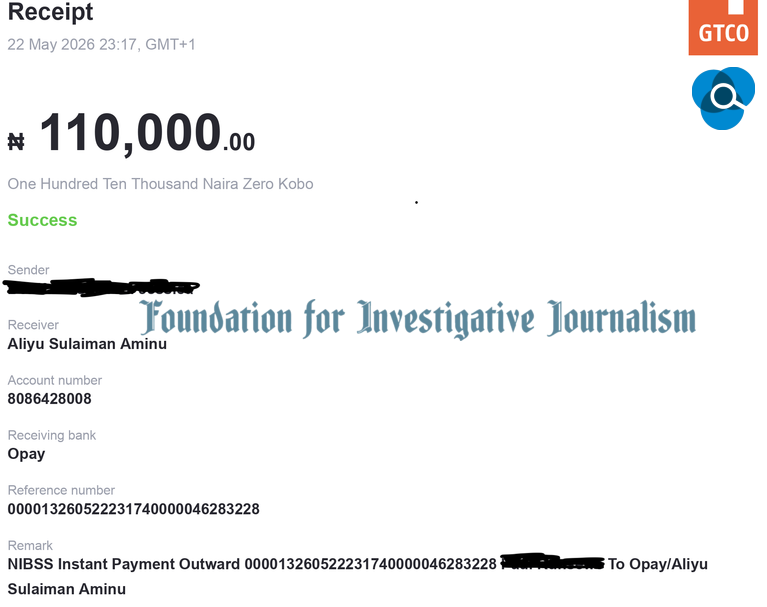
N110,000 sent to Ismael’s boy Aliyu Sulaiman on the say-so of Alhaji Buzu
Knowing I was about to embark on a journey of uncertain return, I lodged at a hotel in Kano to sneak in a nap in what became my only revitalising sleep in nearly 50 days, then contacted Ismael. He wouldn’t tell me where to meet up. Instead, he instructed me to hand my phone to a tricycle driver once I reached the heart of town. Even my tricycle driver did not get a pinpoint description from Ismael after they both conversed in Hausa, consequently ostracising me. Instead, Ismael led him to a location, from where he led him to another location, and then another. The location we believed was the third and final turned out distant from our destination. But waiting there was Mohammed, a young, lanky fellow who led me on a quarter-hour walk through several narrow, low-end streets. Mohammed took a picture of me when we arrived at the ghetto; every new trafficker along the journey to Libya must present this photo to their passenger to prove their vehicle was the correct one to board.
I cast a slow, furtive glance across the compound. A tall, dark, hijab-donning lady was sauntering into the adjoining room. She looked every inch a teenager. A much younger girl emerged from the room to make use of a pit-latrine-cum-bathroom, the size of a telephone booth.
‘YOU CANNOT GO OUT’ — THE FIRST IMPRISONMENT
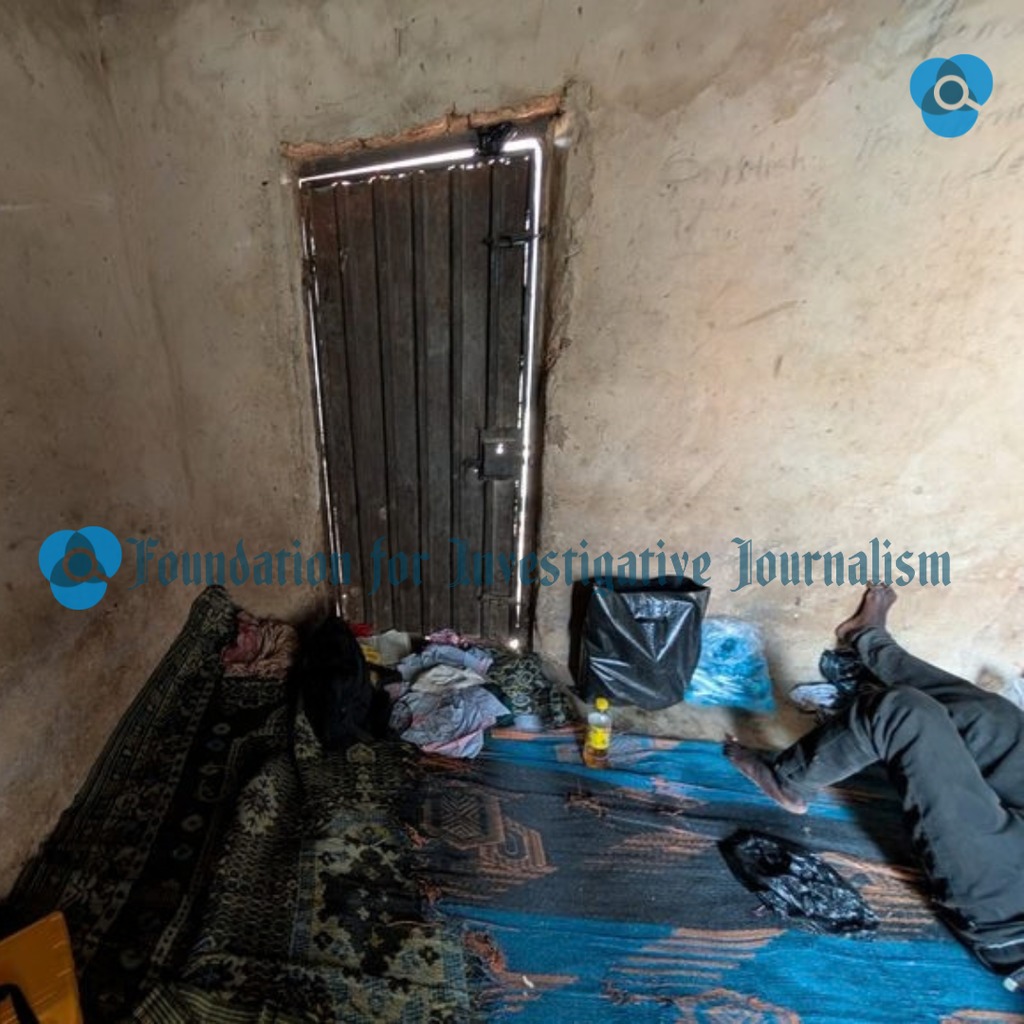
Emmanuel, a native of Imo State, lies on the floor inside a migrant house in Kano. He intends to cross the Mediterranean Sea but has no idea how long it’d take. Photo credit: ‘FISAYO SOYOMBO/FIJ
As the boys polished off their intense prayer session, Mohammed returned to warn me I couldn’t exit the hut at will, irrespective of my need; I had to tell him and he would get it for me. “The police often raid the area,” he said. For whom and why, he didn’t say. But we both knew.
In Libya, the journey we were about to embark on is deemed a crime. According to Libyan laws, “anyone who deliberately obtains for himself or another person a material or non-material benefit, whether directly or indirectly, by commission of any of the acts considered illegal immigration shall be penalised by detention for a period not exceeding one year and a fine of no less than 5,000 Libyan Dinars (LYD) and not exceeding 10,000 LYD”. Also, “if it is proven that the perpetrator belonged to an organised gang for smuggling immigrants at the time the crime was committed, the penalty shall be imprisonment for a period of no less than five years and a fine of no less than 5,000 LYD and not exceeding 30,000 LYD”.
Libya Law No. (19) of 2010 on combatting illegal immigration specifically lists acts of illegal immigration to include the admission of illegal immigrants into the country or removal therefrom by any means, transportation of or facilitating the transportation of illegal immigrants inside the country with knowledge of their illegality, and harbouring illegal immigrants or concealing them in any way from the competent authorities or concealing information about them in order to enable them to reside in the country or depart therefrom.
Nigeria, meanwhile, continues tackling irregular migration through a series of strategies including repatriation and returnee support, policy reforms, public awareness campaigns and crackdowns on traffickers like Mohammed, Ismael and Alhaji Buzu.
POVERTY THE ROOT OF THE MIGRATION EVIL
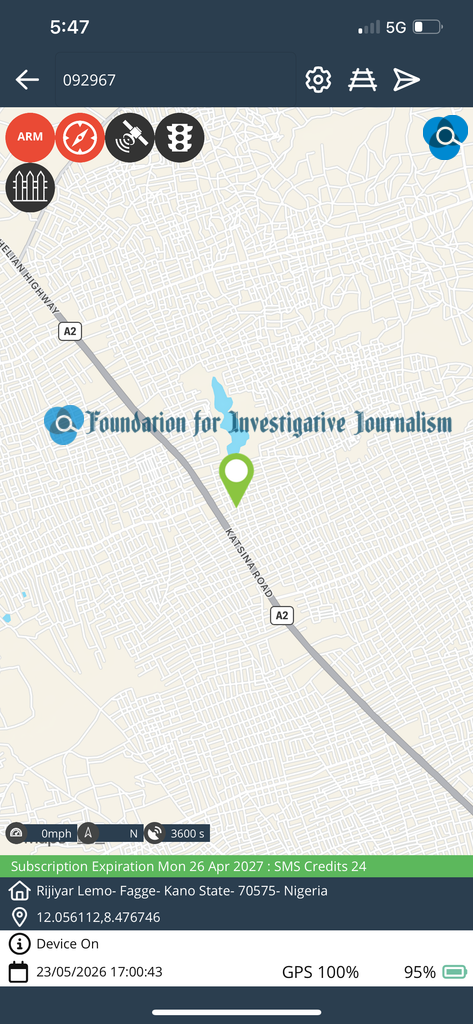
Satellite tracker-monitored location of the migrant house in Kano.
Despite these efforts, the Libyan journey remains bi-directional. The more African migrants get deported to their home countries, the more fresh ones find their way back in, with as many as an estimated 85,000 Nigerians risking their lives on the journey to Libya annually despite a steady decline in success rate for entry into Europe. The reason is clear to all. According to the World Bank, poverty in Nigeria rose to 63 per cent in 2025 despite a slowdown in inflation, underscoring the limited impact of recent macroeconomic improvements on household welfare. For 2026, PricewaterhouseCoopers (PwC) predicted that at least 141 million Nigerians (representing 62 per cent of the population) would live in poverty. “Approximately 33.1 million Nigerians may face food insecurity due to economic hardship and violence in northern food-producing regions,” it added. It was therefore unsurprising that the migrants I encountered on the journey were all united by one thing — a quest for economic prosperity.
Political instability triggered by the toppling of the Muammar Gaddafi regime hasn’t helped, either. Libya has been fractured since the civil war of 2014 to 2020, the northwest controlled by the western-backed government in Tripoli, and the south and the east overseen by warlord Khalifa Belqasim Haftar, whose military government commands several militias exercising authority in the regions. These militias consider themselves legitimate, ostensibly working to enforce peace, security and order, and fighting migration. Under this pretext, they operate migrant detention camps where they torture and film migrants, with the videos sent to their families for the purposes of extortion. This absence of a solitary government has engendered a free-for-all that has been maximally exploited by human traffickers.
Emmanuel from Imo State became my first migrant-friend, striking a conversation with me and surprisingly volunteering unsolicited personal information. A lady in Libya had funded his trip, but he was oblivious of the cost and unaware of her Libyan city of residence. He had deposited N350,000, surely insufficient to cover half the overall costs. He also had no idea how long he would stay in Libya before crossing the Mediterranean Sea. Tall, dark, and well-built. He did not appear to know what he was doing!
A MIGRANT’S ACCOMMODATION
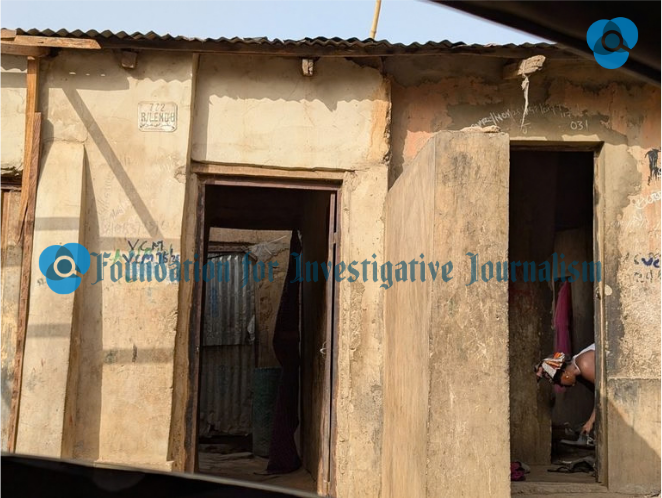
The exterior of the house where a group of migrants, including the journalist, passed the night on May 22, 2026. Inset (L) is a door made of corrugated roofing sheet leading to the bathroom-pit-latrine. Inset (R) is a woman stooping to wear her shoes. Photo credit: ‘FISAYO SOYOMBO/FIJ
When I woke up the following day, I resumed looking at the house searchingly. The all-round restriction of movement in such constricted space gave it the feel of a prison. You also paid for everything other than breathing. A night’s sleep cost N500. It was N300 for a bucket of water for a bath, and N200 for half a bucket. If you charged your phone, you paid N200. And if Mohammed bought you food or water, the cost was extortionate. He — not the shop — told you the price of whatever item you purchased.
The inner room occupied by men had no window or mattresses. The walls were brown and pale. There were two raffia mats on the floor for more than 15 of us to sleep on. I slept with folded legs due to the human congestion. The room offered no ventilation, save the door space with no door. The patio right outside the room was roofless; it became useless when it rained briefly.
A car had come over the night to pick half the men, the other half converging on the verandah to chat idly away while I remained in the room, listening in on them. A young man in his early 30s said his girlfriend was in the other room. Both of them were plotting to cross the sea into Europe. They had left their two kids back home in the southwest. He dismissed concerns about his girlfriend embarking on such a treacherous journey. “She’s not scared,” he remarked. “She’s even more animated about the journey than me. All that matters to her is that we’re physically together.”
‘MOTOR DON COME’!
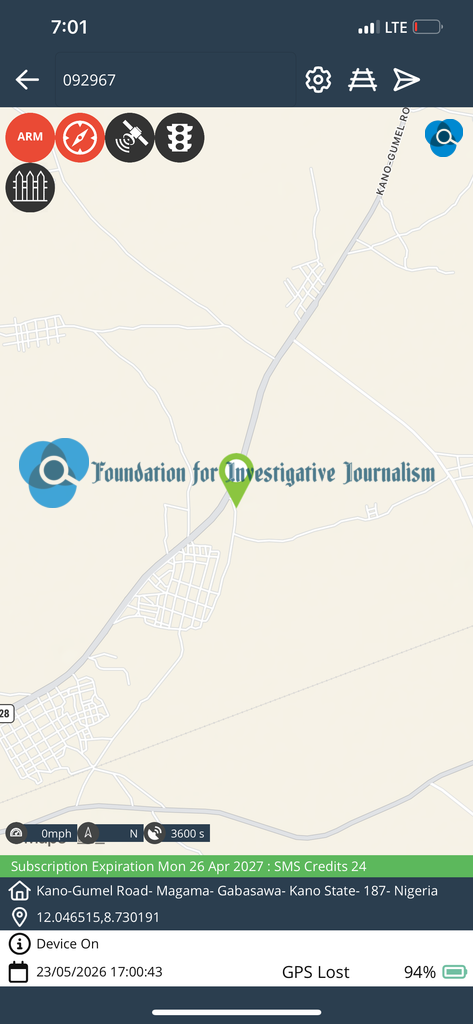
Satellite tracker-powered GPS image of my journey out of Kano
Motor don come!’ — I was roused from siesta at about 4:20pm on Saturday May 23. Mohammed hurried and harangued me out of the room while the aged woman stewarding the ghetto hounded me for money for a night’s worth of sleep. Two of the driver’s accomplices sat in the car’s front seat, but nine of us were forced into a backseat designed for three passengers.
One passenger requested to use my phone — to speak with her mother who was unaware she was embarking on the journey. The trip was indeed her aunt’s making. She dialled her mother twice but the calls went unanswered. She described herself to me as “Emmanuella, Ella for short”, but I insisted on knowing her native name. Ogochukwuamaka. She looked no more than 17, maybe 18. She hails from Ebonyi, Nigeria’s fourth smallest state, in the southeast, but grew up in Ikorodu. All three females in the car looked roughly 15 to 18. All were deceptively robed in hijabs. They displayed conspicuous cluelessness about the dangers ahead.
READ ALSO: From Nigeria to Burkina Faso: Undercover as a Trafficked Person
The driver ignited his engine at exactly 4:57pm, accelerating north of Kano city. Notable landmarks on the journey included the Abubakar Imam Urology Centre and, in quick succession, Luxury Furniture City. We drove along the Kano-Gumel-Road-Magama-Gabasawa highway and cut through a part of Katsina before eventually pulling up in Ungongo at exactly 7.41pm.
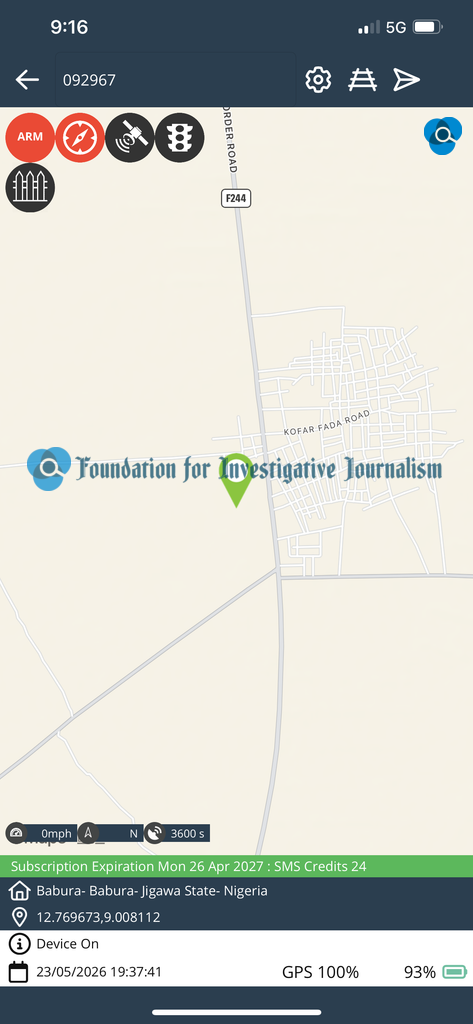
Satellite monitoring of my location showing we briefly touched Jigawa territory en route to Magaria
Within two minutes, two motorcycles sped towards us and pulled over swiftly. The driver lined all nine of us up, sized us up, and waved four of us onto the two motorcycles. I was one of the first four. As we were climbing, three more motorcycles pulled over to collect the other five.
In under three minutes, all nine of us were gone, the riders operating at breakneck speed through undulating bush paths with no landmarks. Sometimes, they linked up with tarred roads, but it was always brief and they always diverted to the bush. It was a stunningly reckless ride. I started to pray; it was too early to die; we hadn’t even left Nigerian territory yet!
Occasionally, the riders stopped to make a phone call, then resumed the journey at dizzying speed. After more than an hour through an admixture of bumpy bush paths, rocky swamps and patchy quicksand, the riders stopped us in Magaria, an agrarian town in the Zinder region of Niger, just north of the Nigeria border. Another ghetto!
WELCOME TO NIGER REPUBLIC
The thatched hut in Magaria where we were led to on arrival in Zinder. There are several of these in the area. Inset (top right) is a refuse dump near the restaurant patronised by migrants. Photo credit: ‘FISAYO SOYOMBO/FIJ