WHEN THE MOURNER-IN CHIEF GOES TO THE COMMANDER-IN-CHIEF
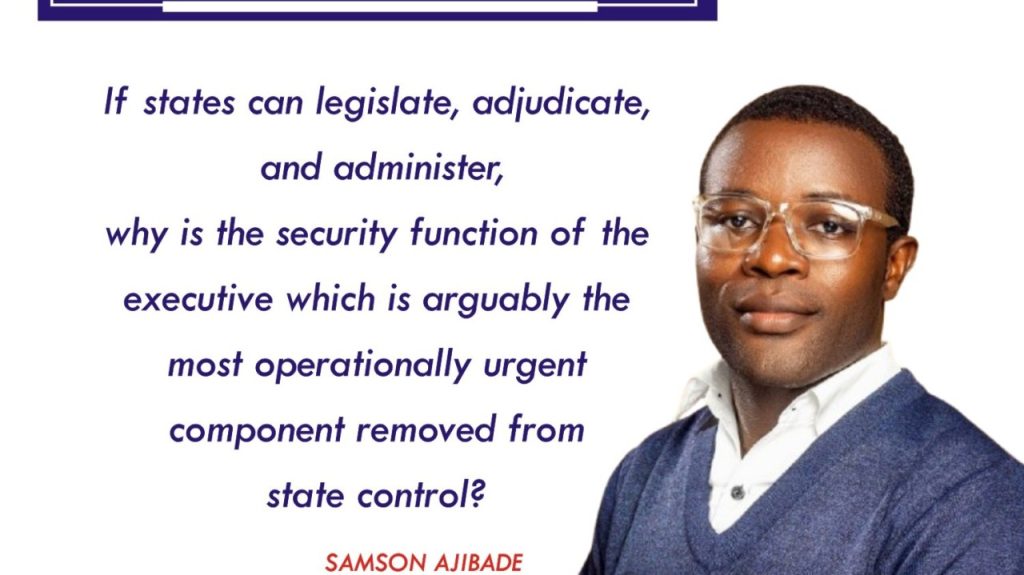
SAMSON O. AJIBADE | CRIMINOLOGIST & SECURITY RESEARCHER
If states can legislate, adjudicate, and administer, why is the security function of the executive which is arguably the most operationally urgent component removed from state control?
It has become a norm for state governors to seek audience with the President and Commander-in-Chief of the Armed Forces to brief him on the state of security whenever there is an attack and the state needs a swift response. After this, in the case of abduction and kidnapping, the Federal Government then steps in to ensure the victims are released. It’s two weeks after the kidnapping and abduction in Oyo, one of the victims, a teacher was beheaded in captivity while others languish in the forest, including a-2 year old kid and other lads.
Why can’t the federal government deploy a tactical team swiftly to respond before the terrorists go far with the victims, then the Governor briefs the C-in-C later armed with the report from the Commissioner of Police and other security agencies?
Nigeria is a federal state which maintains its own legislative houses, judiciaries, and executive bureaucracies. A state governor controls a budget, appoints commissioners, directs civil servants, and administers justice through state high courts. Yet, when armed bandits attack a village at midnight, the governor must call Abuja for permission to respond or rush to the Commander – in – Chief to explain what transpired.
This is an absurdity!
The argument against state policing in Nigeria is based on the fears of political weaponisation, the prospect of governors deploying state police against political opponents. This is a legitimate concern with precedent. But it cannot rationally serve as a permanent barrier against community self-defence. The question the security establishment has refused to honestly answer is this: if states can legislate, adjudicate, and administer, why is the security function of the executive which is arguably the most operationally urgent component removed from state control?
This is because the monopoly of security provides the federal government with leverage over state-level political actors. It concentrates coercive power at the centre in a manner that suits elite interests across party lines. Citizens like the people of Oriire then pay the price for this. This is why Criminologists and Security Experts have consistently argued that the highly centralised structure of the Nigerian Police Force weakens community level crime prevention and undermines effective policing within rural areas.