STUDENT KILLED, OTHERS SHOT AS ARMED ROBBERS HELD ERUKU HOSTAGE AMID QUESTIONS OVER POLICE RESPONSE

FINAL YEAR STUDENT MURDERED
At about 1:00 a.m. on Tuesday, 28 July 2026, armed robbers launched one of the most devastating attacks in recent years on Eruku Community, Itori, Ewekoro Local Government Area of Ogun State. The community, situated outside the gates of D.S. Adegbenro ICT Polytechnic, serves as home to hundreds of students who chose the area because of its proximity to the institution.
The Polytechnic was in the middle of its examination period. Many final year students were preparing to complete their studies and leave campus after years of academic struggle. Anticipating the security concerns that often accompany sign out celebrations, the institution had reportedly prohibited sign out parties. That decision may have prevented an even greater catastrophe. Rather than striking within the campus environment, the armed gang targeted the off campus student community.
Between 1:00 a.m. and 2:00 a.m., the attackers carried out coordinated raids on at least three or four student residences. They forced their way into buildings, moved from room to room, and dispossessed occupants of their valuables at gunpoint.
The operation bore the characteristics of an organised robbery syndicate. Cash was not their only objective. Their principal targets were expensive smartphones, particularly Samsung devices and Apple iPhones, which command substantial value within illegal resale markets. Victims disclosed that owners of iPhones were compelled to deactivate their iCloud security before the criminals departed, a deliberate tactic intended to frustrate digital tracking and device recovery.
Throughout the operation, the attackers repeatedly discharged firearms, creating panic across the community and preventing residents from rendering assistance to victims.
A Higher National Diploma final year student, Rufai Sekinat Ajoke from the Department of Marketing, only days away from graduation, was shot and killed.
Another student, Emmanuel Olatunbosun Olonade, a National Diploma student of the Department of Public Administration who was also expected to complete his programme next week, sustained multiple gunshot wounds.
After collapsing in his own blood, the wounded student reportedly summoned extraordinary courage, dragging himself towards a nearby residence while calling for help. Residents remained trapped indoors because the attackers continued firing sporadically across the neighbourhood. Eventually, one of his friends risked his own life to evacuate him to Sodipo Hospital at Oremeji, Itori, where emergency treatment commenced before the management of D.S. Adegbenro ICT Polytechnic facilitated his transfer to the Federal Medical Centre, Abeokuta, for advanced medical care.
Another female student reportedly sustained severe injuries after part of her ear was cut during the violent assault.

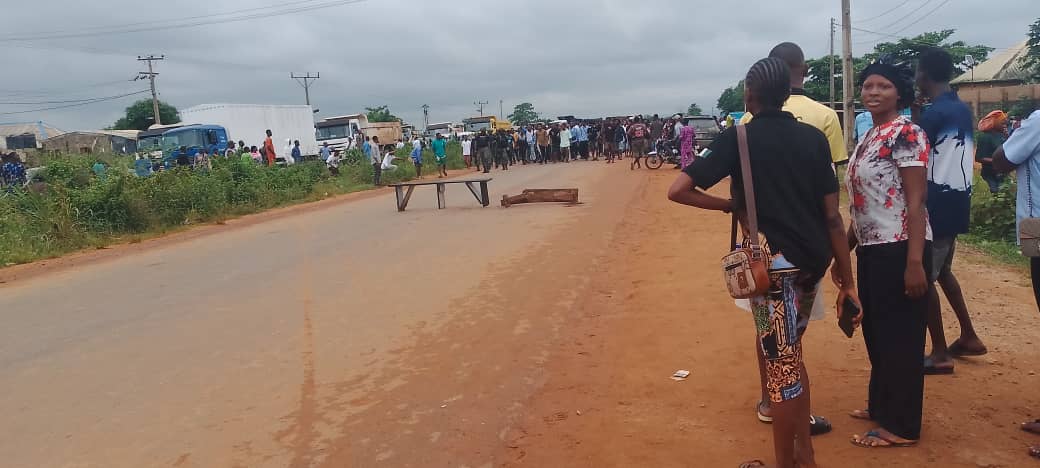
The fact remains that Eruku has become one of the most insecure student settlements surrounding the Polytechnic. Numerous students described a persistent pattern of burglary in which criminals cut through windows during the night before stealing mobile phones and other valuables while occupants slept. Such incidents have become so frequent that many students now regard them as part of everyday life.
Residents also recounted repeated theft of electricity cables from community transformers, leaving entire neighbourhoods without electricity on several occasions. The frequency of those incidents suggests the activities of organised criminal networks operating with disturbing confidence.
Perhaps the most troubling aspect of this investigation concerns the apparent absence of an immediate security response.
Notably, the palace of the Olu of Eruku is located about two minutes from the scene, while the Itori Divisional Police Headquarters is approximately three minutes away by road. Yet heavily armed criminals reportedly operated within the community for an extended period, repeatedly firing weapons without any immediate tactical intervention. The police didn’t respond until the early hours of the day. Does it mean the police didn’t hear gunshots from their station? Several students stated that emergency calls were placed to the Police while the attack was ongoing, but no deployment was made.
This raises questions that demand official answers.
- Why was there no immediate police response despite the proximity of the Itori Divisional Police Headquarters to the scene?
- Why were heavily armed robbers able to operate for an extended period without tactical intervention?
- Why did the emergency calls reportedly made by students fail to trigger a timely security response?
These questions deserve transparent administrative scrutiny because public confidence in policing depends not just on investigations after attacks but on rapid intervention during attacks.
Several students interviewed during this investigation alleged that officers attached to the Itori Divisional Police Headquarters routinely conducted stop-and-search operations within Eruku that frequently resulted in harassment, extortion, and arbitrary arrests. The Special Weapons And Tactical (SWAT) Base before Arigbajo is just 15 minutes away from Eruku, yet stealing and robbery persist in the area. Students interviewed alleged that officers often arrived in a Lexus RX330 patrol vehicle, where they conducted stop and search operations, accused students of internet fraud, and demanded money before releasing those detained.
One incident repeatedly cited during this investigation involved a student, "Leke" (pseudonym), who was unlawfully arrested after stepping out to purchase groceries from a roadside kiosk operated by a Hausa trader adjacent to the palace of the Olu of Eruku. According to his account, he immediately identified himself as a student of D.S. Adegbenro ICT Polytechnic and informed the officers that his father is a pastor. He alleged that the officers ignored his explanation, manhandled him, and attempted to force him into their patrol vehicle without stating any offence he had committed. Leke stated that his repeated cries for help attracted the attention of the Olu of Eruku, who reportedly intervened and directed the officers to release him.
While questions remain regarding the external security response, the management of D.S. Adegbenro ICT Polytechnic acted swiftly after receiving information about the shooting. Officials visited the injured student at Sodipo Hospital and immediately coordinated his transfer to the Federal Medical Centre, Abeokuta, ensuring that he received higher level medical attention.
The incident also exposes another serious public safety concern. Itori lacks a government owned secondary healthcare facility capable of providing specialist trauma care for gunshot victims, victims of serious road crashes, and other life threatening emergencies. In trauma medicine, survival is frequently determined by the speed with which definitive treatment becomes available. The absence of such a facility unnecessarily prolongs emergency evacuation and increases preventable risks.
The repeated criminal activities reported within Eruku suggest a deteriorating security environment around one of Ogun State's tertiary institutions. Effective policing around tertiary institutions requires predictive patrol deployment, threat assessment, rapid response capability, emergency call management, intelligence led policing, and continuous engagement with host communities. The recurrence of violent crime within the Eruku axis suggests that the existing security architecture requires urgent operational review.
The Ogun State Government should urgently strengthen security around Eruku and other student communities surrounding D.S. Adegbenro ICT Polytechnic through coordinated multiagency interventions. The Inspector General of Police and the Commissioner of Police, Ogun State Command, should institute an investigation into the conduct and response of the Itori Divisional Police Headquarters during the attack, including emergency call handling, deployment timelines, command decisions, and operational readiness. Allegations of extortion, arbitrary arrests, harassment, and other reported human rights violations attributed to officers operating within Eruku should receive impartial investigation, while officers found culpable should face appropriate disciplinary procedures.
The Ogun State Government should also establish a government owned secondary healthcare facility in Itori to strengthen emergency medical response for students and surrounding communities.
The Chairman of Ewekoro Local Government should publicly outline measures being implemented to improve the security of student communities and explain how complaints concerning alleged misconduct by security personnel are being addressed. Community leaders, educational institutions, residents, and security agencies should jointly establish structured security partnerships centred on intelligence sharing, emergency communication, neighbourhood surveillance, and coordinated crime prevention.
For the families affected, graduation week has become a period of mourning rather than celebration. For surviving students, the attack has intensified fears about living in a community where violent criminals reportedly operated for nearly an hour without immediate security intervention. Whether this tragedy leads to institutional reforms now depends on how quickly the relevant authorities account for the operational failures raised in this investigation and implement measures to prevent a recurrence.